Why score ad copy before you spend?
Behavioral targeting gets your ad in front of the right person. The copy decides whether they engage. Most ad copy testing happens after launch: you run the variants, wait for click data, kill the loser, iterate. The problem is you're burning budget on every cycle before you know what failed and why.
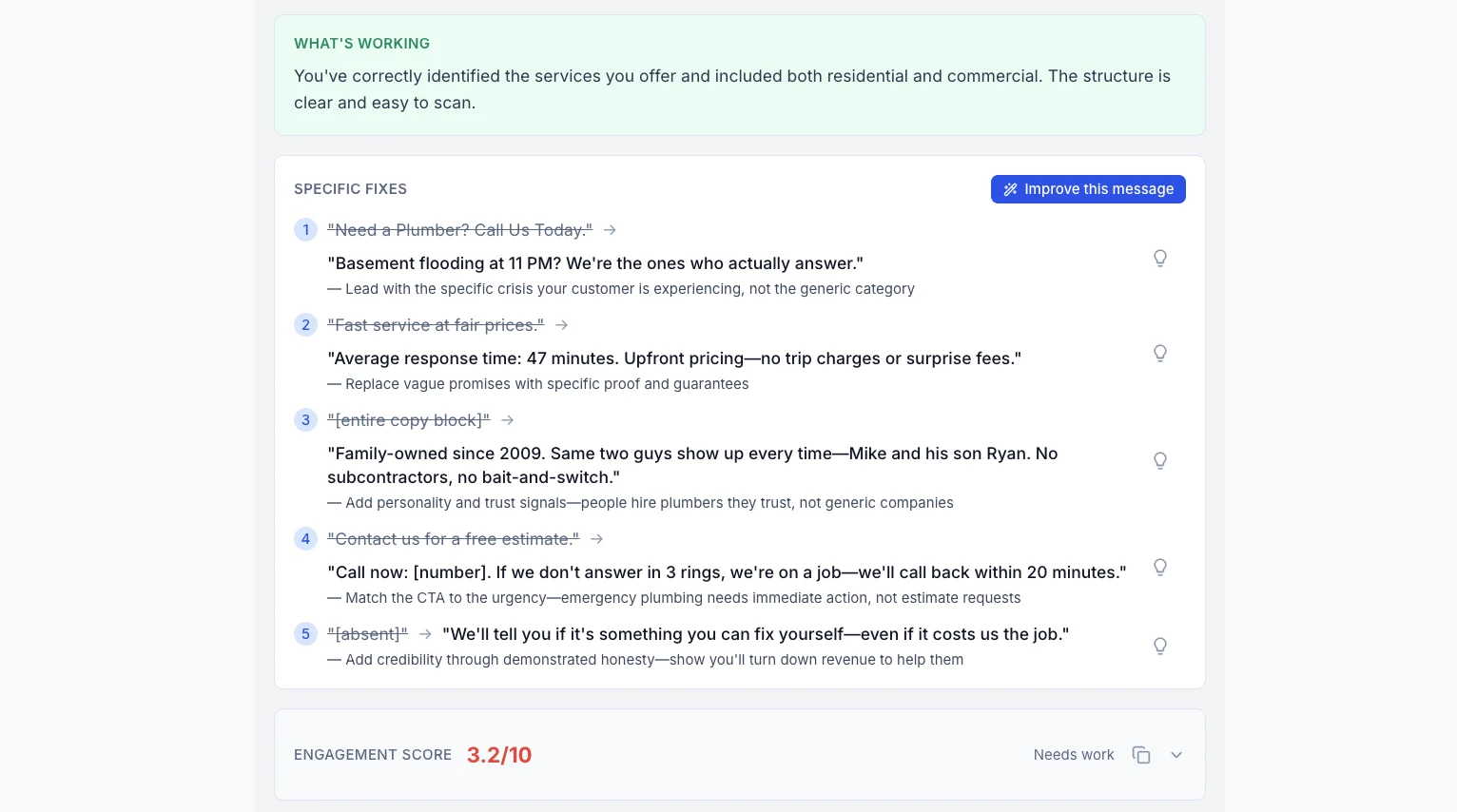
This free ad copy analyzer compresses the cycle. Paste a Google ad, a Facebook ad, a LinkedIn promoted post (whatever format you're testing) and the tool scores it across four communication frameworks: Engagement, Personality fit, Strategic Clarity, and Framing Strategy. The 0–10 dimensional scores show exactly which psychological levers your copy pulls and which it misses for the audience you defined.
What the four frameworks measure
Engagement (HAPE): the emotional pull of the copy (how it activates curiosity, identity, social connection, agency, validation, and the other engagement vectors). Low Engagement scores show up as copy that reads as competent but flat.
Personality fit (Big Five / OCEAN): how the copy maps against your target audience's personality profile across Openness, Conscientiousness, Extraversion, Agreeableness, and Neuroticism. A high-Conscientiousness enterprise buyer responds to specifics and proof; a high-Openness early-adopter wants concept and implication. Mismatch on this axis is why ads with strong targeting still underperform.
Strategic Clarity: does the message align with a coherent business outcome? Ad copy that's clever but unclear about what action it wants (or what category the product is in) scores low here. Strategic Clarity is the discipline gap between "fun ad" and "ad that converts."
Framing Strategy: which cognitive frame is the copy operating in? Loss-aversion, identity, status, social proof, scarcity, possibility — the frame shapes how the offer lands. The analyzer surfaces the primary frame and flags when the frame fights the audience's decision style.
Use this before you launch a Google Ads or Facebook Ads campaign
For paid-search work (Google ad copy), the analyzer flags the gap between specifics-language and benefit-language that often hurts high-Conscientiousness enterprise buyer ads. For Facebook ad copy, the personality-fit dimension catches when copy written for a single decision-maker ignores the social-proof signals high-Agreeableness audiences need. For LinkedIn promoted posts, the analyzer surfaces when the platform-default credentialing frame is undercutting the actual offer.
Set the platform when you paste the ad. The frameworks adjust for platform-specific format constraints (character limits, structural conventions) so a Google headline doesn't get scored against the same yardstick as a long-form LinkedIn post.
Bring your draft. We score the personality fit.
Paste ad copy you've written, your agency wrote, or an AI tool wrote. The analyzer scores it across four personality-grounded frameworks (Engagement, Personality fit, Strategic Clarity, Framing Strategy) drawn from 860+ peer-reviewed papers on consumer psychology — so you see which half of the buying committee your draft lands with before you spend. For full generate + score workflows tailored to a specific buyer's OCEAN profile, the SEMalytics app delivers per-buyer drafts grounded in the same framework architecture.
Want the full SEMalytics analysis with rewrite guidance? Sign up for SEMalytics to get framework-specific rewrites for every gap the analyzer surfaces, plus 200 analyses per month.
Start FreeHow the scoring works
The analyzer wraps the same four-framework engine used inside the SEMalytics platform — the engine that powers enterprise ad copy scoring for paid teams. The free tier runs the full analysis once per request (no LLM tricks, no stripped-down model), capped at 3 analyses per IP per day. Higher volume + the rewrite layer + score history live in the paid product.
The scoring is calibrated on 860+ peer-reviewed papers of communication and personality psychology research — not a vibes-based "ad rater" trained on a corpus of marketing tweets. That's why the dimensional breakdown is actionable: each low score points to a specific psychological gap with a known fix vocabulary.
What to do with a low score
Low Engagement: rewrite the headline to activate a sharper engagement vector — curiosity gap, identity signal, or efficacy claim. Don't just add adjectives; change the emotional architecture.
Low Personality fit: identify which OCEAN dimensions your audience scores high on and rewrite the body to address them. High-Conscientiousness audiences need specifics + proof; high-Agreeableness audiences need peer validation + team-outcome framing; high-Openness audiences need concept + implication.
Low Strategic Clarity: rewrite the CTA and the value proposition. Often the fix is removing options ("Learn More" + "Get Started" + "Talk to Sales" creates clarity drag) and tightening the category claim.
Low Framing Strategy: pick a different cognitive frame. If the current frame is benefit-claim ("Save 30% on…"), try identity ("For ops leaders who…") or possibility ("What if your team…"). The right frame depends on where the buyer is in the decision cycle.