The Psychology Research Behind B2B Content Intelligence
The peer-reviewed literature is consistent: high-converting B2B messages activate specific psychological triggers across all five buyer personality types simultaneously, not just the one or two most copy reaches.
In 60 seconds, discover which triggers your B2B copy activates, and which are silently repelling buyers. Seven frameworks. 860+ peer-reviewed studies. One analysis.
What Personality Psychology Research Reveals About B2B Messaging
Personality-Matched Messaging
Facebook ads matched to recipients' personality traits achieved up to 40% more clicks and 50% more purchases vs. non-matched ads (Matz, Kosinski, Nave & Stillwell, 2017, PNAS).
Distinct Buyer Personalities
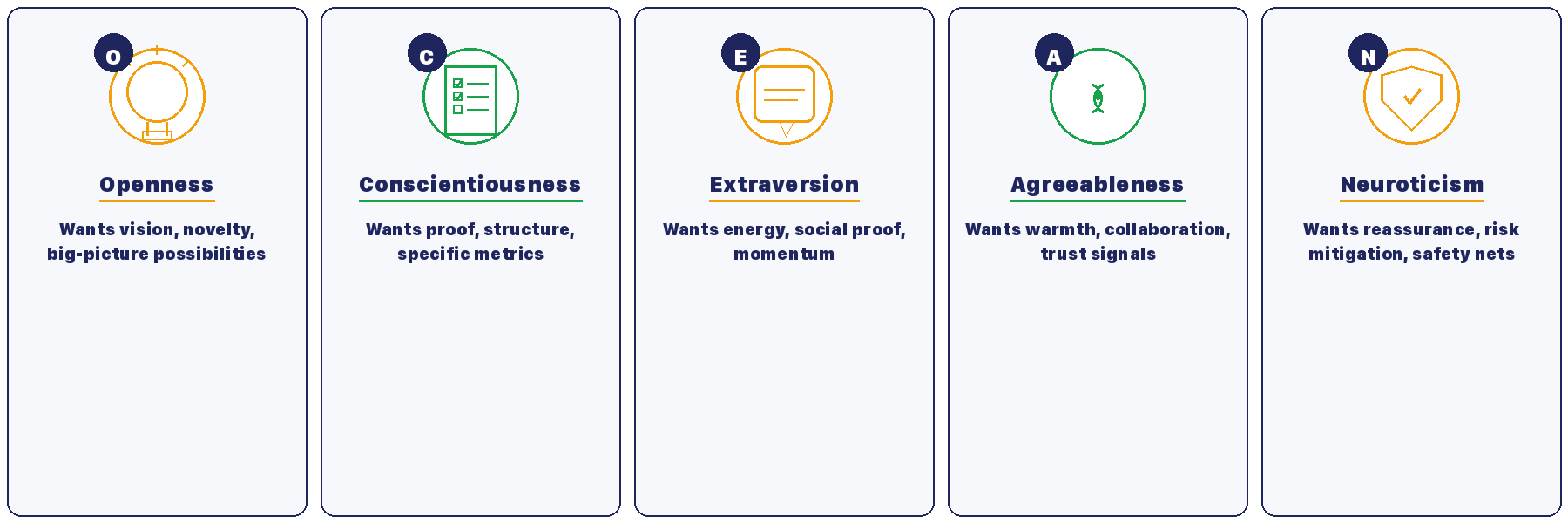
The Big Five model identifies five stable personality dimensions that predict communication preferences, validated across 40+ languages (Costa & McCrae, 1992).
Lost to Pressure
High-pressure persuasion tactics trigger reactance — buyers detect manipulation and withdraw, often without consciously articulating why (Brehm, 1966; reactance theory).
How Leading B2B Brands Miss Buyer Personality Types
We ran real homepage copy from well-known B2B companies through COS. The personality gaps are striking, and common across industries:
Global Strategy Consulting Firm
34% Coverage"Partners with leaders on strategy, innovating to net zero, building capabilities for a sustainable future."
- → Misses analytical buyers (no specifics or metrics)
- → Misses cautious buyers (vague promises, no proof)
- → Connects only with big-picture, high-Openness thinkers
AI Project Management Platform
52% Coverage"AI work platform. Agentic AI products that deliver results across projects and engineering."
- → Misses detail-oriented buyers (what results, specifically?)
- → Undifferentiated; could describe any AI tool
- → Appeals to early adopters, alienates cautious evaluators
Work Management SaaS
47% Coverage"Manage your team's work, projects, and tasks online. Stay focused on goals."
- → Generic; describes every PM tool on the market
- → Emphasizes effort, not outcomes or transformation
- → Misses relationship-oriented and warmth-seeking buyers

Run your own copy through the same analysis.
Check Your Personality CoverageThe 4 Triggers That Drive B2B Decisions
High-converting messages activate all four. Most copy hits one or two—and loses the rest of the pipeline.
Proof for the Skeptic
Analytical buyers will not engage until they see evidence. Engagement scoring measures 8 psychological triggers (including social proof, specificity, and credibility markers) to identify exactly where your proof is weak.
Connection for Every Personality
Some buyers need relationship signals. Others want details. Some crave vision. Big Five profiling shows which personality types your copy naturally reaches, and which it accidentally repels.
Alignment That Feels Right
When your claims do not match your proof, buyers sense it even if they cannot articulate why. Strategic Clarity catches the misalignment that creates "something feels off" responses.
Trust Without Pressure
Sophisticated buyers detect manipulation and withdraw. Push too hard and you lose them. Framing Strategy ensures you are building trust—not triggering buyer resistance.

Is Big Five Copy Optimization Actually Research-Backed?
Yes, specifically. Here are the primary findings that ground the 860-paper corpus.
Does personality-matched copy actually outperform generic copy?
Yes, at scale. Matz, Kosinski, Nave and Stillwell (2017, PNAS) ran Facebook advertising to 3.5 million people: personality-matched ads produced up to 40% more clicks and 50% more purchases versus generic ads to identical audiences. Hirsh, Kang and Bodenhausen (2012) confirmed the effect in controlled conditions: participants rated personality-tailored messages as significantly more persuasive and reported higher purchase intent, even when unaware the targeting was happening.
How many peer-reviewed studies back the OCEAN model?
Thousands, across 40+ languages. The Big Five has been replicated continuously since Costa and McCrae (1992) with consistent factor structure across cultures, making it the closest thing personality psychology has to a universal model. COS draws on 860+ papers spanning seven research domains: Big Five personality targeting, persuasion psychology, engagement science, framing strategy, strategic clarity, content quality, and platform optimization.
Can you detect personality from written copy?
Yes. Park et al. (2015, Journal of Personality and Social Psychology) analyzed 75,000+ people and found language-based personality profiles predict self-reported traits about as accurately as a close friend would. Personality shows up in the language you write and shapes how your copy lands on different readers.
What happens when copy does not match buyer personality?
Buyers disengage without articulating why. Reactance theory (Brehm, 1966) shows mismatched persuasion triggers a withdrawal response, amplified in high-Conscientiousness and high-Neuroticism buyers. Processing fluency research (Alter and Oppenheimer, 2009) confirms that harder-to-process content feels less trustworthy. Most B2B copy naturally reaches 1 to 2 of the 5 personality profiles and silently repels the rest.
860+ Peer-Reviewed Studies: The Research Foundation
Not trend pieces or marketing blogs — the academic research that establishes why personality-based messaging outperforms generic content intelligence tools. We show our work.
Peer-reviewed papers inform our methodology
- Costa & McCrae (1992). NEO Personality Inventory established the five-factor model as the most reliable personality framework in psychology — replicated in thousands of studies across disciplines.
- Validated across 40+ languages and cultures with consistent factor structure, making it the closest thing psychology has to a universal model of human personality (McCrae & Costa, 1997).
- Hirsh, Kang & Bodenhausen (2012). Participants shown personality-tailored advertising messages rated them as significantly more persuasive and reported higher purchase intent vs. generic versions — even when unaware the targeting was happening.
- Matz, Kosinski, Nave & Stillwell (2017). Facebook advertising study: personality-matched ads achieved up to 40% more clicks and up to 50% more purchases compared to non-matched ads to the same audiences. Effect sizes held across Openness and Extraversion targeting. Replicated at 3.5M-individual scale in follow-on work (Matz & Kosinski, 2019).
- Calibrated personality targeting outperforms generic; over-personalization or visibly-inferred targeting can trigger reactance and attitude reversal (Steindl et al., 2015; Amarnath & Jaidev, 2023). COS calibrates targeting to minimize misfit risk.
- Soto & John (2017). Validated the next-generation BFI-2 measurement instrument with improved bandwidth, fidelity, and predictive power across personality assessment contexts — the modern operationalization of the Big Five.
- Park et al. (2015). Big Five personality traits are measurably expressed in written language: a study of 75,000+ people found language-based personality profiles correlated r = 0.35–0.43 with self-reports — comparable to the agreement between friends rating one another (Journal of Personality and Social Psychology).
- Fleischhauer et al. (2010). High-Openness individuals show greater Need for Cognition (r = 0.50) — the trait predicting preference for argument-based, elaboration-rich processing (Petty & Cacioppo, 1986). Effect corroborated by Sadowski & Cogburn (1997) in the original Big-Five factor structure work; published in Personality and Social Psychology Bulletin.
- COS maps content language to Big Five trait expressions using semantic similarity, showing which personality types your copy naturally connects with and which it misses — with specific rewrites for each gap.
- Noar et al. (2007). Meta-analysis of 57 studies: message-tailoring interventions consistently produce significant advantages over generic messaging across a wide range of audience-tailored communication outcomes (small-to-modest aggregate effect; larger effects within specific moderator conditions). The strongest B2B-relevant magnitude estimates come from personality-matched advertising studies (e.g., Matz et al., 2017; Matz & Kosinski, 2019 — 40% clicks / 50% purchases).
- Cialdini (1993). Six principles of influence — reciprocity, commitment, social proof, authority, liking, scarcity — synthesize decades of social-psychology research on what shifts behavior.
- Petty & Cacioppo (1986). Elaboration Likelihood Model: evidence-oriented buyers process persuasion via the central route (deep, evidence-based evaluation), while affect-driven buyers use the peripheral route (heuristics, affect, social signals). Copy that works for one route often fails for the other.
- Green & Brock (2000); van Laer, de Ruyter & Visconti (2014). Narrative transportation theory: stories reduce counterarguing and increase persuasion by engaging identity-relevant emotions — meta-analytically validated across consumer contexts by van Laer and colleagues (Journal of Consumer Research). High-Agreeableness and high-Openness audiences are most susceptible to narrative engagement; analytical buyers require data integration alongside narrative.
- Loewenstein (1994); Qiu & Golman (2024). Information-gap theory: curiosity is triggered when people are aware they lack specific knowledge. A modern field test analyzing over 100,000 WeChat news articles — with NLP-extracted measures of salience, importance, and surprisingness — confirms the mechanism: headlines that activate a knowledge gap collect significantly more clicks (Qiu & Golman, 2024, Applied Cognitive Psychology).
- COS evaluates which persuasion principles your copy activates and which cognitive-route matches are missing, then generates targeted rewrites for each gap.
- Berger & Milkman (2012). Analysis of 7,000+ New York Times articles: high-arousal positive emotions (awe, excitement) and high-arousal negative emotions (anxiety, anger) each significantly raise the odds of an article being shared. Per-SD effects (Table 4, Model 4): awe and practical-value increase shared-list odds by ~30%, anger by ~34%, anxiety by ~21%, while sadness suppresses sharing odds by ~16%.
- Pivecka, Ratzinger & Florack (2022). Cross-platform replication: a study of 3,000+ political tweets from Austrian party leaders confirms the arousal-virality finding on Twitter — high-arousal emotional content drives significantly more social transmission, generalizing Berger & Milkman's NYT finding to a different platform and content domain (Frontiers in Psychology).
- COS measures 8 emotional engagement triggers across your content: awe, excitement, interest, curiosity, anger, anxiety, social connection, and efficacy — each validated in the peer-reviewed literature as a driver of attention and action.
- Fredrickson & Kahneman (1993); Kahneman (2011). Peak-End rule (r ≈ .58 in the canonical experiments; Fredrickson & Kahneman, 1993, JPSP; popularized in Kahneman, 2011, Thinking, Fast and Slow): how an experience opens and closes dominates how it is remembered and evaluated — the middle matters less than intuition suggests. COS evaluates your emotional arc and flags weak openings and closings.
- Heath & Heath (2007). Six principles of "stickiness" in Made to Stick (Simple, Unexpected, Concrete, Credible, Emotional, Story) align with engagement dimensions COS measures. The Unexpected principle — violating audience expectations in the first sentence — is the most reliable attention trigger across personality types.
- Cacioppo & Petty (1982). Need for Cognition research: audiences with high need for cognition respond to argument quality and central-route processing; low-NFC audiences respond to peripheral cues. Generic copy that ignores this split loses one group or the other.
- Kong, Zhu & Konstan (2020). In high-trust professional contexts, the engagement challenge is at the click/action layer, not the inbox — most trusted organizational emails are opened (Proceedings of the ACM on Human-Computer Interaction, CSCW).
- Lasky-Fink & Rogers (2022). Value-signaling subject lines reliably outperform static generic variants — even modest signal specificity slows engagement decay (PLOS ONE). Effect size measured in educational-email interventions (~3% lift); B2B magnitude context-dependent.
- Social proof and identity cues are particularly powerful in B2B contexts where decision-makers seek validation from peers before committing budget — and particularly among high-Agreeableness and high-Conscientiousness buyers.
- Aubin Le Quéré & Matias (2025). Meta-analysis of 8,977 studies (Scientific Reports): curiosity-gap headlines that over-promise BACKFIRE. Concreteness raises information-seeking and engagement, while vague teases erode trust. Implication for B2B copy: tell readers what they get, don't make them gamble on a click.
- Brehm (1966). Reactance theory: when people feel their freedom to choose is threatened, they resist — even when the offer is genuinely beneficial. The stronger the perceived pressure, the stronger the resistance response. This effect is amplified in high-Conscientiousness and high-Neuroticism buyers, who are most sensitive to autonomy threats.
- High-pressure tactics reduce conversion specifically in sophisticated B2B buyers who have been through enough sales cycles to recognize manipulation patterns. The detection doesn't need to be conscious — subtle autonomy cues register below the threshold of awareness and still generate resistance.
- Deci & Ryan (1985, 2000). Self-Determination Theory: intrinsic motivation — doing something because it aligns with your own goals and values — produces more durable behavior change than extrinsic pressure. B2B messaging that frames decisions as buyer-initiated rather than seller-pushed consistently outperforms high-urgency alternatives in long-cycle sales.
- Fogg (2003). Persuasive Technology framework: the most effective digital persuasion reduces friction and increases perceived agency rather than applying pressure. B2B buyers who feel in control of the evaluation process convert at higher rates and churn at lower rates.
- Autonomy-respecting messaging builds deeper trust by letting buyers reach their own conclusions — and high-trust relationships in B2B are a key predictor of contract renewal and expansion (Gartner B2B Purchase Research, 2022).
- Lee & Aaker (2004); Higgins (1997). Effective framing matches the audience's motivational orientation: promotion-focused audiences respond to gain-emphasis and ideal-outcome framing; prevention-focused audiences respond to safety-emphasis and loss-avoidance framing. Lee & Aaker's regulatory-fit experiments (Journal of Personality and Social Psychology) demonstrate the mechanism; Higgins established the theoretical foundation in American Psychologist.
- COS flags manipulation markers, urgency language, and pressure tactics — and generates replacements that achieve the same outcome through autonomy-aligned framing rather than reactance-triggering pressure.
- Gans & Zhan (2023); van Laer et al. (2014). Framing the persuasive message inside a story before making the ask inoculates audiences against the resistance it would otherwise trigger. Van Laer et al.'s meta-analysis of 66 consumer studies confirms narrative transportation reduces counter-arguing and lifts attitude change (Journal of Consumer Research). Gans & Zhan apply the mechanism: narrative immersion before the ask reduces the autonomy-threat signal that drives reactance (International Journal of Communication, 2023).
- Mayer, Davis & Schoorman (1995). Trust in a counterparty — vendor, partner, or seller — is built on three perceived components: Ability (do they have the skill to deliver?), Benevolence (do they care about my interests?), and Integrity (do they honor commitments?). This Ability-Benevolence-Integrity (ABI) framework, established in Academy of Management Review and cited 21,000+ times, remains the dominant model in trust research three decades later.
- Vanneste, Puranam & Kretschmer (2014). Inter-organizational trust does grow over time — but the effect is small and conditional. A meta-analysis of 39 studies in the Strategic Management Journal identifies four mechanisms (initial-bias correction, change in relationship value, identification, trust-based selection) that determine whether trust strengthens, plateaus, or erodes across the buyer-seller relationship lifecycle.
- COS scores Strategic Clarity along these dimensions: does the copy demonstrate Ability through specifics and evidence, signal Benevolence through audience-respecting framing, and prove Integrity through internal consistency between claim and proof? Misalignment is what buyers register as "something feels off."
- Rosengren, Eisend, Koslow & Dahlen (2020). Advertising creativity reliably lifts attention, brand attitudes, and behavioral intentions — a meta-analysis of 93 effect-size datasets across 67 studies in the Journal of Marketing finds creativity effects are robust across contexts and act primarily by raising elaboration and meaningfulness.
- Tannenbaum et al. (2015). Emotional appeals — especially well-calibrated fear appeals — reliably shift attitudes, intentions, and behaviors. A 127-paper meta-analysis of 248 independent samples in Psychological Bulletin concludes fear appeals are effective at positively influencing attitude, intentions, and behaviors with no identified backfire conditions.
- Alter & Oppenheimer (2009). Easier-to-process content is more persuasive: processing fluency — the subjective ease of mental processing — lifts perceived truth, liking, and persuasive impact. Clearer fonts, more concrete language, and shorter sentences all increase fluency and all raise persuasive judgments (Personality and Social Psychology Review).
- COS evaluates Quality across the three Made-to-Stick dimensions these papers anchor: Creativity (novel construction vs. familiar pattern-matching), Emotional resonance (calibrated emotion vs. flat affect), and Fluency (easy to process vs. taxed by jargon, complexity, abstraction).
- Unnava & Aravindakshan (2021). Brand engagement does not stay where you post it: a Journal of the Academy of Marketing Science study modeling brand posts across Facebook, Twitter, Instagram, and YouTube finds significant within-platform and cross-platform spillover effects. Each platform's engagement responds both to its own past activity and to brand activity on the others — a brand's social presence must be modeled as a multi-channel system, not as independent platform silos.
- Platform format produces distinct audience responses even for matched content — IG Stories vs Facebook Wall generate different ad attitude, intrusiveness perception, and loyalty intent (Belanche et al., 2019, Spanish Journal of Marketing).
- COS scores Platform-Specific Optimization by recognizing that the same message lands differently on each channel: LinkedIn rewards depth and proof; Twitter rewards arousal and brevity; email rewards specificity and information-gap headlines. Optimal copy adapts to each platform's native conventions while preserving the message's strategic intent.
Personality-Based Marketing: What Each Buyer Type Needs
The Big Five model identifies five stable personality dimensions. In B2B marketing, each dimension predicts distinct content preferences, persuasion routes, and trust triggers. Content intelligence means knowing which ones your copy activates.
High Openness
Vision-oriented buyers who respond to novelty, conceptual thinking, and future-state framing. They engage with bold claims but disengage quickly from operational detail.
Activated by: metaphors, possibilities, "imagine if," contrarian positions, big-picture outcomes.
Repelled by: feature lists, step-by-step instructions, excessive process detail.
High Conscientiousness
Detail-oriented, risk-averse buyers who need evidence, specificity, and proof before committing. The most common profile in B2B finance, operations, and procurement.
Activated by: specific metrics, case study data, implementation timelines, certifications, ROI calculations.
Repelled by: vague promises, hyperbole, unsupported claims.
High Extraversion
Socially oriented buyers who respond to energy, community signals, and peer validation. Dominant in sales, marketing, and business development roles.
Activated by: customer stories, community language, social proof, action-oriented CTAs, enthusiasm.
Repelled by: dry, technical prose; passive voice; long blocks of unbroken text.
High Agreeableness
Relationship-first buyers who need warmth, trust signals, and assurance before they'll engage. Common in HR, customer success, and non-profit leadership roles.
Activated by: testimonials, collaborative language ("together," "partnership"), ethical commitments, genuine warmth.
Repelled by: aggressive CTAs, competitive framing, anything that feels pushy or transactional.
High Neuroticism (Risk Sensitivity)
Risk-sensitive buyers who need reassurance, low-friction paths, and explicit safety signals before they'll move forward. Underserved by almost all standard B2B copy.
Activated by: money-back guarantees, trial offers, "cancel anytime," support availability, step-by-step onboarding.
Repelled by: urgency tactics, ambiguous terms, overly enthusiastic claims that feel too good to be true.
Most B2B copy naturally activates 1–2 of these profiles. Content intelligence means engineering your messaging to reach all five — without sounding like it was written by a committee.
Frequently Asked Questions About Personality-Based Content Intelligence
The Research Is Clear. The Question Is What Your Copy Does With It.
When you match messaging to buyer personality types, it outperforms generic copy across every study in the literature. COS applies that research to your specific content — paste any B2B copy and see your personality coverage score, which buyer types you're missing, and exactly what to change. Try the free ad copy analyzer to put the research on your own copy — no signup, 3 analyses per day.
7-day free trial · No credit card required