In this guide
Why buyer psychology matters for B2B copy
Standard copywriting frameworks (benefit-first, objection-handling, social proof) work better for some buyers than others. Not because the frameworks are wrong, but because they assume a single persuasion route.
A high-Conscientiousness buyer evaluates methodically. They want data, specific numbers, structured argument. Social proof works if it comes with specific metrics attached. Abstract vision statements make them skeptical.
A high-Openness buyer responds to ideas first. They want to understand the mechanism before they want the proof. Leading with a data table before the insight risks losing them before you've made the concept legible.
The OCEAN model as a copywriting framework
The Big Five personality model: Openness, Conscientiousness, Extraversion, Agreeableness, Neuroticism: is the most validated framework in personality psychology. Each dimension predicts how a person processes new information, evaluates claims, and decides to act.
For copywriters, each dimension maps to a concrete set of writing decisions.
Openness: mechanism first vs. proof first
High-Openness buyers engage with novel framing. They want to understand what your product means: the category insight, the mechanism, the "this changes how you think about X" argument. Lead with the concept. Proof validates a mechanism they've already found interesting.
Low-Openness buyers want precedent. Not "here's a new way to think about this": "here's evidence this works at companies like yours." Case studies outperform thought leadership. Specific outcomes outperform category arguments.
Conscientiousness: evidence density and argument structure
High-Conscientiousness buyers process evidence systematically. They expect structure: ordered argument, specific numbers rather than ranges, clear methodology. They'll read a dense section if it's organized. They lose trust when claims aren't specific.
Low-Conscientiousness buyers want the headline, then the option to dig deeper. Long evidence chains produce drop-off. Lead with the outcome. Put detail below the fold or behind a link.
Extraversion: social proof vs. individual-outcome framing
High-Extraversion buyers are energized by what their peers are doing. "How teams like yours are using this" works. Industry references, community language, and peer validation carry persuasive weight.
Low-Extraversion buyers evaluate independently. They discount "everyone's switching to this": it reads as social pressure, not evidence. Individual-outcome framing ("what this produces for you") works better. Social proof works as supporting evidence, not as the hook.
Agreeableness: partnership vs. capability framing
High-Agreeableness buyers respond to collaborative language. "We help you" over "we outperform the competition." They respond to trust signals, who is behind the product, shared values, mission alignment.
Low-Agreeableness buyers are more competitive. "What you get that others don't" is more persuasive than "we're in this together." Direct value statements read as credible; collaborative language reads as soft.
Neuroticism: risk-removal vs. upside framing
High-Neuroticism buyers (lower Emotional Stability) are attuned to threat. Risk-removal framing converts better: what happens if you don't act, the cost of the status quo, guarantees, safeguards. Pure upside pitches feel incomplete.
Low-Neuroticism buyers respond to growth and opportunity. The upside is the argument. Risk-mitigation language reads as defensive.
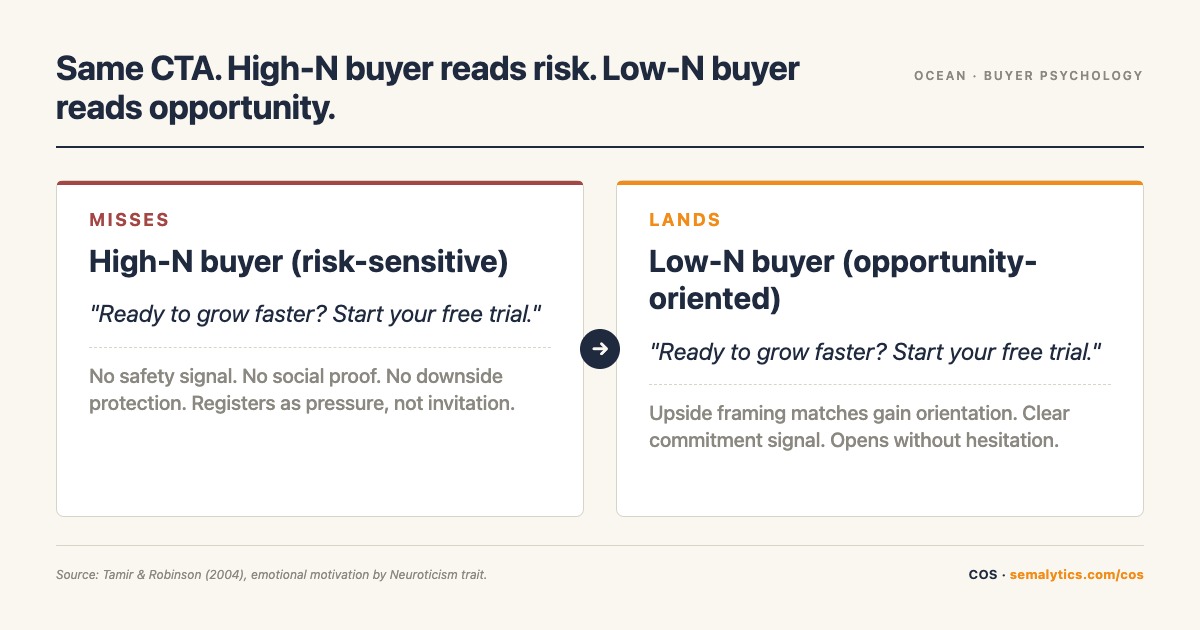
Same CTA, two different reads. Neuroticism determines whether upside framing works or registers as pressure.
Cialdini principles mapped by OCEAN dimension
The six Cialdini influence principles don't work equally for every buyer. High-Conscientiousness buyers respond to authority and specific evidence; high-Neuroticism buyers respond to scarcity and safeguards. The match:
| Cialdini principle | Works best for |
|---|---|
| Authority (expert, data, credentials) | High-Conscientiousness |
| Social proof (peers doing it) | High-Extraversion |
| Scarcity / urgency | High-Neuroticism |
| Liking (relationship, shared identity) | High-Agreeableness |
| Reciprocity (give first, ask later) | High-Agreeableness |
| Commitment / consistency (small yes first) | High-Conscientiousness, High-Openness |
The mistake is applying a single Cialdini frame to the full list. A scarcity play aimed at a low-Neuroticism buyer reads as cheap pressure. An authority play aimed at a high-Openness buyer who hasn't found the concept interesting yet reads as evidence before insight.
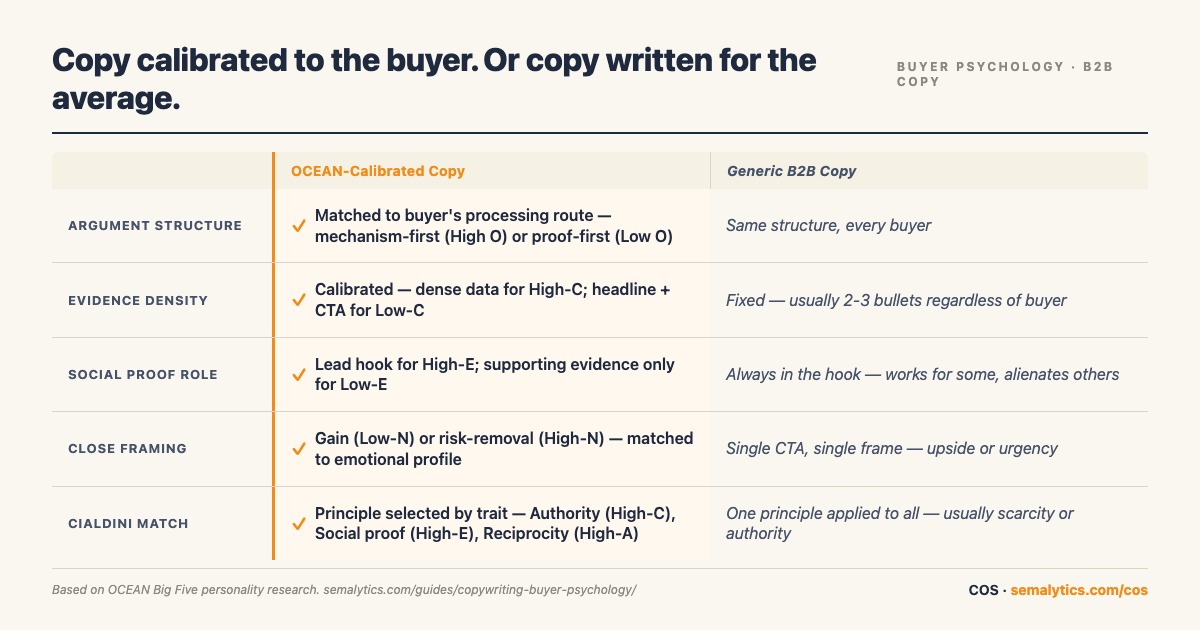
What changes when copy is calibrated to the buyer: across five dimensions of the argument.
What this means for B2B buying committees
B2B buying committees typically include multiple stakeholders with measurably different personality profiles. A VP Finance and a VP Marketing at the same company have different OCEAN signatures: different Conscientiousness levels, different Openness distributions, different risk sensitivity.
One set of campaign assets doesn't serve both. The Finance stakeholder needs dense evidence, risk-removal framing in the CTA, individual-outcome language. The Marketing stakeholder needs the concept established first, peer reference as validation, upside framing.
The same product argument, calibrated differently by dimension, reaches both.
Score any B2B email, ad, or outbound message against the OCEAN model: see exactly which buyer types it's calibrated for and which it misses.
Try FreeHow SEMalytics applies buyer psychology to copy scoring
Manually mapping buyer psychology to copy decisions works for one buyer. At scale (across a buying committee, a list of 2,000, a paid campaign) it breaks down.
SEMalytics scores every piece of B2B copy against the OCEAN model using frameworks drawn from 860+ peer-reviewed papers. The score surfaces which dimensions the copy is calibrated to and which it misses: a Conscientiousness gap, a Neuroticism framing mismatch, an Extraversion-heavy social-proof hook aimed at a predominantly introverted buyer set.
The same analysis generates calibrated variants per buyer type: the VP Finance version and the VP Marketing version, each fitted to the OCEAN signature of the reader. The mechanism and evidence behind the scoring are on The Science page.