Every piece of B2B copy you write goes through an invisible filter before it persuades anyone. That filter is personality.
Not "brand personality." Buyer personality.
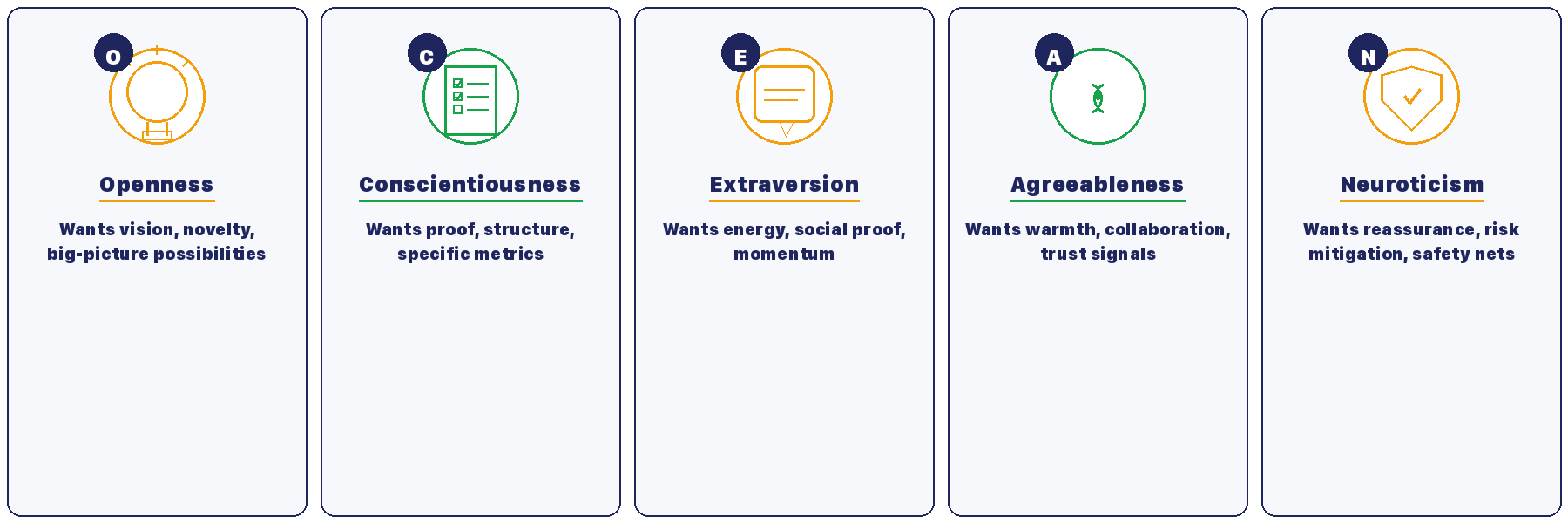
The Big Five personality model (also called OCEAN) is the most validated framework in personality psychology — replicated across 40+ languages, with decades of peer-reviewed research behind it. It identifies five stable dimensions that predict how people process information, make decisions, and respond to persuasion:
- Openness — Drawn to vision, novelty, big-picture possibilities
- Conscientiousness — Needs proof, structure, specific metrics
- Extraversion — Responds to energy, social proof, momentum
- Agreeableness — Seeks warmth, collaboration, trust signals
- Neuroticism — Requires reassurance, risk mitigation, safety nets
Here's the problem: most B2B copy only speaks to one or two of these types. And it's not because the writing is bad — it's because this is a blind spot that's nearly impossible to see in your own work.
The Typical Pattern
We've analyzed B2B messages across industries through COS. The pattern is remarkably consistent:
The "Visionary" Trap
Startup copy tends to over-index on Openness. Words like "innovative," "revolutionary," "transform" light up high-O readers — but leave analytical and cautious buyers cold. They need specifics and safety, not vision.
The "Data Dump" Trap
Enterprise copy swings the other way — all metrics and case studies with no warmth or excitement. Technically credible, emotionally flat. It satisfies the analytical buyer but loses the relationship-driven one.
The "Trust Me" Trap
Investor-facing copy often scores high on authority but low on proof. "We're crushing it" triggers skepticism in exactly the analytical buyers you need to convince.
The good news: once you see which personalities you're missing, the fixes are usually small. You're not rewriting — you're filling gaps.
What Personality Coverage Actually Looks Like
Consider this real example:
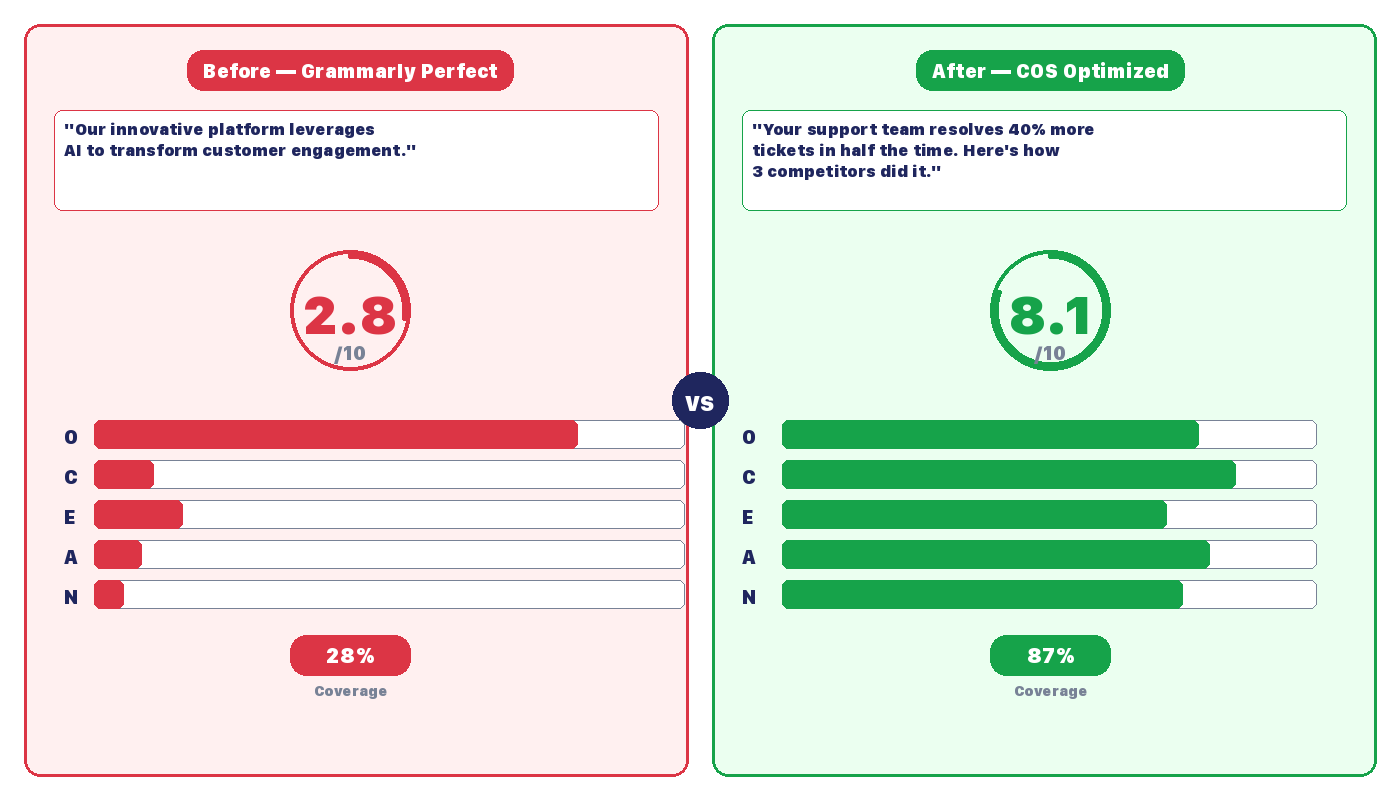
"Our innovative platform leverages AI to transform customer engagement."
COS score: 2.8/10 · 28% personality coverage · Only reaches high-Openness buyers
This sentence only resonates with high-Openness buyers. Four out of five personality types feel nothing when they read it.
Now compare:
"Your support team resolves 40% more tickets in half the time. Here's how 3 competitors did it."
COS score: 8.1/10 · 87% personality coverage · All five buyer types covered
Same product concept. What changed?
- Conscientiousness: Specific metric (40%, half the time)
- Extraversion: Social proof (3 competitors)
- Agreeableness: "Your team" — collaborative framing
- Neuroticism: Implicit risk reduction (others already did it, safe to follow)
- Openness: Still present (improvement narrative)
One sentence. Five personality types covered. The difference isn't writing quality — it's psychological targeting.
Why Grammar Checkers Miss This
Grammar checkers and AI writing assistants optimize for clarity, readability, and tone. All valuable. None of them measure which personality types your copy actually reaches.
You can have a grammatically flawless, clearly written, beautifully formatted email that completely fails to connect with 60-80% of your audience. Not because the writing is bad — because the psychology is incomplete.
Where COS Fits in Your Workflow
COS isn't replacing your writing tools. It sits between drafting and polishing — one step that catches the psychological gaps your other tools can't see:
- Draft in your tools
- Analyze in COS (about a minute)
- Fix personality gaps
- Polish grammar and readability
- Send with confidence
You keep your existing workflow. COS adds one checkpoint that ensures you're reaching all five buyer types before you hit send.
Try COS on your own copy
Paste any B2B copy — email, landing page, LinkedIn post, sales outreach — and see your personality coverage score.
Analyze Your Copy FreeFree 7-day trial · Your content stays private · Plans from $24.50/mo
The buyers you're missing aren't ignoring your message. They're just not seeing themselves in it. And now there's a way to check before you publish.